
By: Stanley Dy, Senior Vice President, Operations
The single most common objection to outsourcing retail CX isn’t cost, quality, or security. It’s this: “They won’t sound like us.”
It’s the governance question behind every serious evaluation of digital customer experience services: the retailers with the best customer experience ecommerce has to offer didn’t get there by accident — they built a stack for it.
It’s a fair concern, and dismissing it is a mistake. For a consumer brand, voice isn’t decoration — it’s a substantial part of what the customer is actually buying. A support interaction that sounds generic doesn’t just resolve a ticket poorly; it quietly revises the customer’s sense of who they’re dealing with.
But the concern argues for a specific governance approach rather than against outsourcing altogether. Brand voice at scale is a solvable problem. It’s just solved with structure rather than good intentions.
How Do Outsourced Teams Protect Brand Voice in Customer Experience?
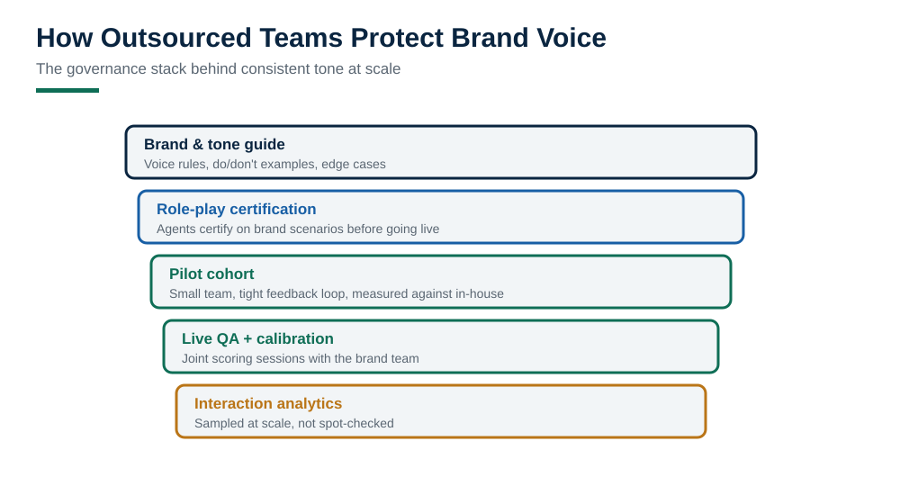
The stack that actually works
A brand and tone guide comes first, and it needs to be more useful than an adjective list. “Friendly but not casual” tells an agent nothing. Paired examples do: here is how we respond to a delayed delivery, here is how we don’t, and here is why. Edge cases matter more than the standard script, because the standard script was never the risk.
Certification before going live. Agents role-play brand scenarios and are signed off before they touch a live customer. This is standard practice for product knowledge and oddly rare for voice.
A pilot cohort, deliberately small, measured against the in-house baseline on the same contact types. This is where you find out whether the guide is actually teachable, and it’s far cheaper to discover that with eight agents than eighty.
Live QA with joint calibration. Not the partner scoring themselves and reporting a number — the brand team and the partner’s QA team scoring the same interactions and reconciling the differences. Divergence in scoring is the earliest signal that voice is drifting.
Interaction analytics at volume. Spot-checking twenty conversations a week tells you about twenty conversations. Analytics across the full interaction set tells you whether tone is holding as headcount scales — which is precisely when it tends not to.
Where AI helps and where it doesn’t
There’s a version of this conversation where automation is the villain, and it’s half right. Automating a judgment-heavy, brand-sensitive interaction does flatten voice.
But used as an assist rather than a replacement, the same technology helps. Knowledge surfacing means an agent has the right context in front of them, so they sound informed instead of scripted — which is usually what customers mean when they say an interaction felt impersonal. Interaction summaries and quality insights make QA continuous rather than sampled. Inspiro’s principle here is that technology should work quietly in the background, keeping interactions personal and effective.
The honest version of the answer
Can an outsourced team sound exactly like your in-house team on day one? No. Neither can a new in-house hire.
The right question is how fast the gap closes and how it’s measured. If a prospective partner can’t answer that with a certification process, a pilot design, and a calibration cadence, the concern about brand voice is well-founded — not about outsourcing in general, but about that partner in particular.
Brand Attributes Are Partnered On, Not Assumed
Choosing the right partner hinges on their ability to truly integrate with your brand. Inspiro takes a thoughtful approach, ensuring brand attributes are not just referenced but actively instilled in agents as foundational knowledge. This isn’t about storing guides in shared drives—it’s about embedding them into the fabric of agent training, coaching, and quality assurance, making them a driving force in how customer interactions are managed.
Client industry alignment is central to ensuring authentic customer interactions. At Inspiro, agents aren’t just trained in tone — they develop deep, practical knowledge of the brand’s industry. For example, when managing CX for an events services provider, this means achieving not only a robust understanding of the events space but also sharing the client’s passion and commitment to it. This alignment ensures responses feel authentic and informed, as if delivered by someone immersed in the brand, rather than merely following a script.
Results You Can Measure
Inspiro delivers measurable CX and BPS outcomes for Fortune 1000 companies across the US, APAC, and ANZ. Our right-sized model keeps senior practitioners close to your operation, pairing enterprise-grade rigor with boutique-level focus. Integrated CX and BPS ensures back-office accuracy and strengthens front-office performance. For organizations managing complex operations across multiple geographies, this integrated model delivers measurable value at every layer of the business.