
By: Aly Antonio, Senior Vice President, Global Sales and Customer Success
There’s a pattern in mid-market retail right now that looks like a reversal but is really a correction.
For mid-market teams evaluating business process services alongside digital customer experience solutions, there is a question worth asking before signing separate contracts for each.
Should Mid-Market Retailers Consolidate CX and BPS With One Partner?
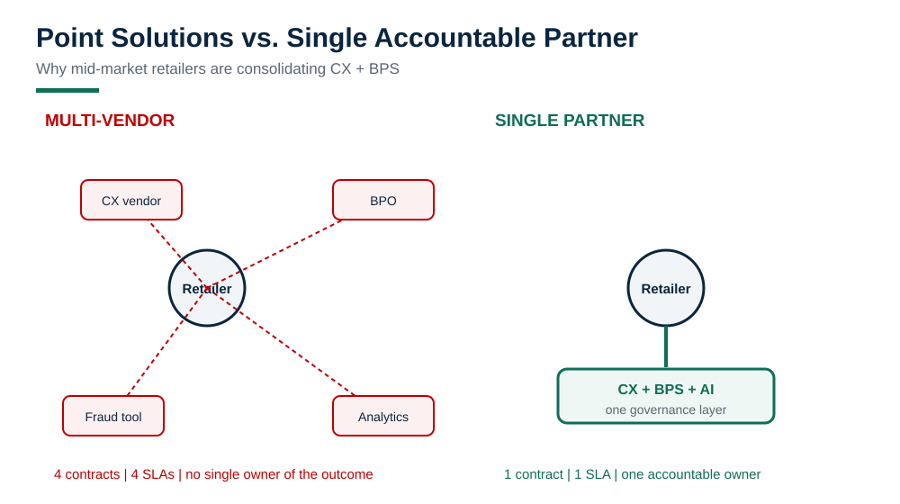
Over the past several years, the sensible advice was best-of-breed: pick the strongest specialist for each function. A CX vendor for support. A separate BPO for back office. A fraud tool. An analytics layer. Each individually defensible.
What’s changed isn’t the quality of specialists. It’s that mid-market teams have discovered where the cost actually lands.
The seam problem
In retail, CX and back-office operations aren’t adjacent — they’re entangled. A delivery exception is simultaneously a customer conversation and a fulfillment problem. A returns backlog is simultaneously a reconciliation issue and a CSAT issue. A fraud flag is a risk decision that a customer is waiting on.
When those live with different vendors, the seam between them becomes the failure point. Not because either vendor is underperforming their SLA — usually both are hitting their numbers — but because nobody owns the total cycle time. Each party optimizes their segment, and the customer experiences the sum.
Mid-market teams feel this more acutely than enterprises for a structural reason: they don’t have a large enough vendor management function to be the integration layer themselves. In a large enterprise, a dedicated team manages the seams. In a 40-person operations org, that team is one person who also has a day job.
What consolidation actually buys
Three things, and they’re worth being specific about because “one throat to choke” is a lazy version of this argument.
Single accountability for outcomes rather than segments. The measurable version: someone is answerable for return-to-refund cycle time end to end, not for their portion of it.
Shared context across the seam. When the CX team and the BPS team share systems and governance, a delivery exception doesn’t require a ticket transfer and a re-explanation. This is where most of the practical time saving comes from.
Proportional governance overhead. One contract, one QBR cadence, one escalation path. For a lean operations team, the management overhead of four vendor relationships is a real and underestimated cost.
The fair counter-argument
Consolidation has genuine risks and it’s worth naming them. Concentration risk is real. A single partner weak in one area drags the whole engagement. And switching costs rise considerably.
Which is why the evaluation question isn’t “should we consolidate?” but “is this partner genuinely strong across all the towers we’d hand them?” A CX provider with a thin BPS practice is worse than two specialists. The consolidation case only holds where the capability is real on both sides.
Inspiro’s positioning — integrated CX and BPS support, with customer-facing and business process operations working together — is exactly the claim that should be tested rather than accepted. Ask how an order exception travels from the customer conversation to back-office resolution and back. If that journey involves an organizational handoff, the seam problem hasn’t been solved. It’s been renamed.
Proof Over Promise
Inspiro’s clients have sustained partnerships averaging over two decades, driven by consistent, measurable results. That longevity isn’t coincidental. It’s built on Lean Six Sigma discipline, senior-level attention, and a delivery model designed to produce outcomes that show up in your KPIs, not just on a slide deck. Beyond contact center operations, Inspiro’s Business Process Services (BPS) extend that same operational rigor to back-office functions, streamlining workflows and reducing process complexity across your entire organization. BPS and CX are integrated by design, meaning back-office efficiency directly powers front-office performance. The result is a seamless, end-to-end delivery model that drives measurable value from topline customer experience to bottom line operational savings. If your company is facing rising costs, quality gaps, or scaling pressure, a conversation with an Inspiro expert is a practical next step.