
Returns are treated as a cost line. They are actually one of the highest-leverage loyalty moments a retailer has. Ask a retail finance team about returns and you will get a number. Ask a retail CX team about returns and you will get a process complaint. Ask a customer about returns and you will get something closer to the truth: returns are the moment they find out whether the brand meant it.
How Can Ecommerce Brands Improve Customer Experience During Returns?
Anyone researching how to improve ecommerce customer experience eventually arrives here: the post-purchase chain, not the checkout flow, is where most of the improvement opportunity actually sits.
The numbers make the case for treating this seriously. The National Retail Federation, in research with Happy Returns, estimated total US retail returns at roughly $850 billion in 2025, with an estimated 19.3 percent of online sales returned. That is not a rounding error in the P&L. But the more interesting figure is a behavioral one: 82 percent of consumers say free returns are an important consideration when shopping online, up from 76 percent the year before.
If 82% of shoppers evaluate the returns policy before they buy, returns are not a post-purchase cost. They are a pre-purchase conversion factor.
That reframing changes where returns should sit in the org chart. A cost center gets optimized for cheapness. A conversion factor gets optimized for experience — and NRF’s own framing is that returns are no longer the end point of a transaction, but an opportunity to create a positive experience that can translate into brand loyalty.
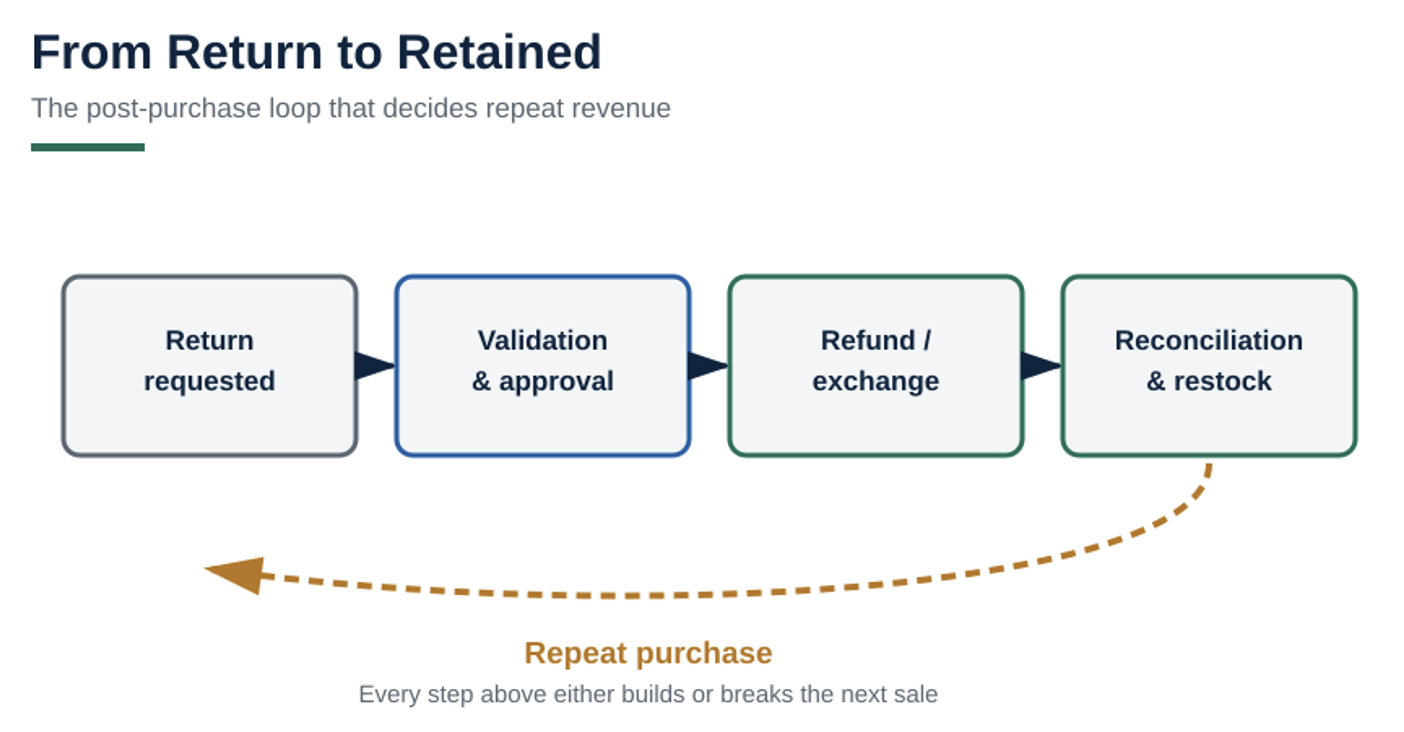
Where the friction actually lives
Post-purchase failure is rarely one dramatic breakdown. It is an accumulation of small handoffs, each of which is somebody else’s job:
- Validation. Is this return eligible? The answer requires order data, policy logic, and sometimes judgment. When those live in three systems, the customer waits.
- Refund execution. The customer has shipped the item back. The refund posts when the warehouse scans it, the finance system reconciles it, and someone triggers the payment — a chain with three places to stall.
- Exception handling. Wrong item, damaged goods, missing components, partial returns on multi-item orders. These are the cases that generate contacts, and they are precisely the cases most workflows do not define.
- Reconciliation and restock. Invisible to the customer, but it determines whether the item is available to sell again this season or next.
Inspiro’s retail BPS model is built around exactly this chain — order management and validation, returns and refunds processing, data updates and account maintenance, inventory and fulfillment support, and exception handling and reconciliation — with the explicit goal that operations remain steady even as post-purchase volume and exceptions spike.
The loyalty math
Here is the part that rarely makes it into the returns business case. PwC’s consumer research found that roughly one in three customers would stop doing business with a brand they love after a single bad experience. Returns are disproportionately likely to be that experience, because they are the interaction where the customer is already mildly unhappy — something didn’t fit, didn’t work, or didn’t arrive as expected.
Handled badly, the return confirms the customer’s emerging suspicion that this brand is not worth the trouble. Handled well, it does something more valuable than a successful delivery ever could: it proves the brand is safe to buy from again. That is why NRF’s data on instant refunds matters — 76 percent of consumers say they are more likely to choose a return option offering an instant refund or exchange. Speed at the moment of doubt is a retention lever.
A practical audit
Retailers looking to find their own friction can start with four measurements, none of which require new technology:
- Return-to-refund cycle time, measured end to end from customer request to money moved — not from warehouse scan.
- Contact rate per return. How often does a return generate a support contact? A high rate means the process is not self-explanatory.
- Exception rate and exception resolution time, tracked separately from standard returns. This is where cost and frustration concentrate.
- Repeat purchase rate among customers who returned, compared to those who did not. This is the number that turns the returns conversation from cost to strategy.
That last metric is the one most retailers have never calculated, and it is usually the one that changes the internal argument. When a leadership team sees that customers with a smooth return experience buy again at a rate comparable to — or better than — customers who never returned anything, returns stop being a leak to plug and start being a channel to invest in.
The sale isn’t the finish line. It’s the start of the relationship that decides whether there is a second one.
Results You Can Measure
Lean Six Sigma-led process discipline has helped Inspiro clients reduce average handling times, improve first-contact resolution rates, and lower cost per interaction. These aren’t projections. They’re documented outcomes built on repeatable methodology and more than two decades of operational experience across industries. Inspiro’s Business Process Services (BPS) extend that same discipline beyond the contact center, applying structured process improvement to back-office functions like finance, HR, and compliance. BPS isn’t a bolt-on. It’s an integrated capability designed to drive efficiency gains across the full business lifecycle, reducing complexity while improving accuracy and throughput. Whether you’re managing high inbound volume or trying to close the gap between your current CSAT scores and where they need to be, Inspiro can show you what that discipline looks like applied to your specific operation.