
Most telecom billing errors originate upstream of the customer call – in provisioning, reconciliation, or account data gaps – and are best prevented through continuous validation rather than a periodic audit. Implementing automated checks across these foundational workflows helps catch discrepancies before they ever hit a customer’s invoice. Ultimately, shifting from reactive corrections to real-time oversight dramatically reduces customer churn and operational dispute costs.
What Causes Billing Errors in Telecom, and How Can Providers Prevent Them?
Most telecom operators treat billing disputes as a contact center problem: a customer calls in confused or angry about a charge, and an agent works the case until it closes. But the dispute itself is almost never where the error originated. It started earlier – in a provisioning step that didn’t sync, a promotion that expired without an update, a usage record that never made it into the rating engine. By the time it reaches an agent, the cost has already compounded.
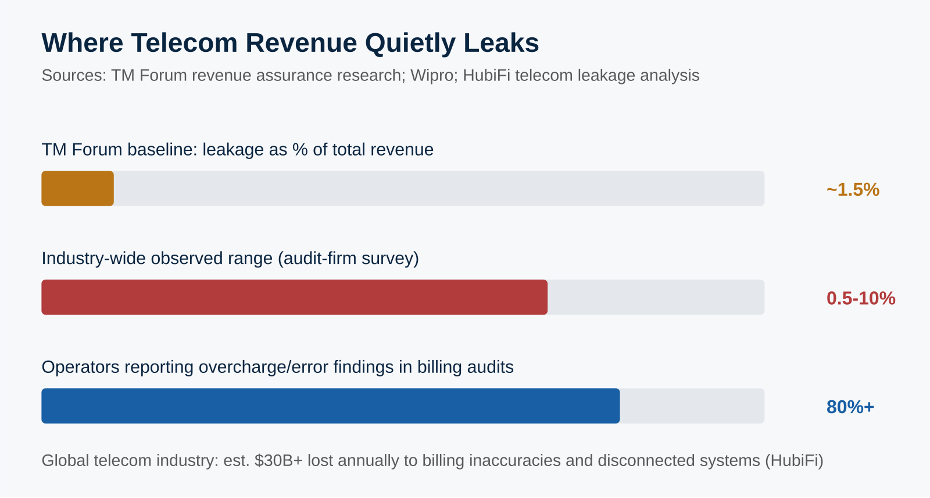
The scale of this upstream leakage is larger than most finance teams assume. TM Forum’s revenue assurance research pegs global telecom revenue leakage at roughly 1.5% of total revenue, driven by unbilled usage, rating errors, and fraud. Other industry audits put the range considerably wider – from 0.5% to as much as 10% of revenue, depending on system maturity and process discipline. And when operators actually go looking, the error rate is high: recent analysis found that more than 80% of telecom billing audits turn up overcharges or errors once someone checks the full population instead of a sample.
The customer-facing consequence is what makes this a CX problem as much as a finance one. A subscriber who is overcharged doesn’t just cost the company the disputed amount – they generate a support contact, often more than one, and they remember the experience. Research from Simon-Kucher’s 2025 global telecommunications study found that existing customers outspend new customers by roughly 7%, which makes billing trust a retention lever, not just an accounting exercise.
This is the core argument for treating provisioning validation, billing reconciliation, and revenue assurance as a single connected discipline rather than three separate back-office functions. Inspiro’s Business Process Services approach applies Lean Six Sigma process design to find and close these gaps upstream – validating provisioning data against orders, reconciling usage and billing systems continuously rather than on a quarterly audit cycle, and feeding findings back into the process instead of just fixing the individual case. The payoff shows up twice: once in protected revenue, and once in a support queue that isn’t absorbing volume that should never have existed.
For telecom operators evaluating where to start, the honest answer is usually not with a new billing platform. It’s with an audit of the order-to-cash lifecycle – provisioning, rating, invoicing, collections – to find out how much of the current dispute volume is actually a symptom of an upstream gap.
Results You Can Measure
Lean Six Sigma-led process discipline has helped Inspiro clients reduce average handling times, improve first-contact resolution rates, and lower cost per interaction. These aren’t projections. They’re documented outcomes built on repeatable methodology and more than two decades of operational experience across industries. Inspiro’s Business Process Services (BPS) extend that same discipline beyond the contact center, applying structured process improvement to back-office functions like finance, HR, and compliance. BPS isn’t a bolt-on. It’s an integrated capability designed to drive efficiency gains across the full business lifecycle, reducing complexity while improving accuracy and throughput. Whether you’re managing high inbound volume or trying to close the gap between your current CSAT scores and where they need to be, Inspiro can show you what that discipline looks like applied to your specific operation.