
Regulated institutions don’t need more dashboards. They need decision support that documents itself. When every operational choice automatically generates its own immutable audit trail, compliance stops being a manual bottleneck. True efficiency means systems that handle the heavy lifting of proof behind the scenes, allowing teams to lead with confidence rather than chase after records.
How is AI changing compliance and risk oversight inside financial services organizations?
Most compliance and risk functions in banking already have more data than they can use – transaction logs, case histories, policy libraries, prior exam findings – spread across systems that don’t talk to each other. The bottleneck isn’t data availability. It’s the time it takes a compliance analyst or risk officer to find the right piece of it at the moment they need it, and the inconsistency that creeps in when different analysts find (or don’t find) different pieces of context for similar cases.
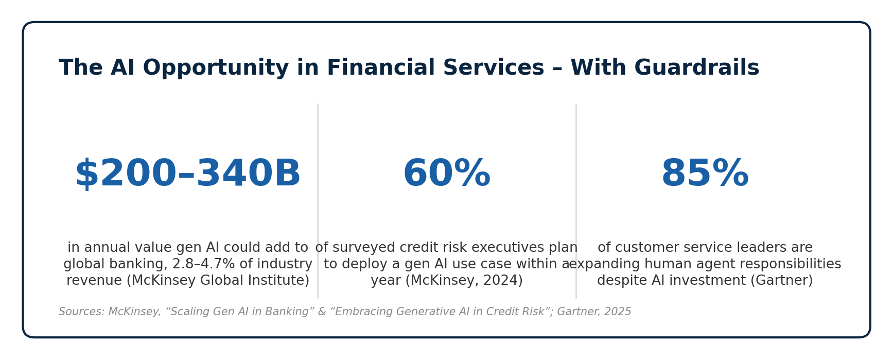
McKinsey’s research on generative AI in banking risk and compliance frames this as a shift from task-oriented compliance work toward AI- and analytics-supported decision environments – what the firm describes as risk intelligence centers that serve every line of defense with consistent, surfaced context rather than siloed lookups. The Global Institute estimates gen AI could add $200–340 billion in annual value to global banking, roughly 2.8–4.7% of industry revenue, with risk and compliance workflows among the highest-value use cases because the underlying work – synthesizing unstructured information, drafting consistent documentation – is exactly what the technology does well.
The practical version of this in a BPS environment looks like workflow intelligence layered onto existing compliance and operations processes: surfacing the relevant policy reference mid-case, summarizing a customer’s prior interaction history before a compliance review, or flagging that a current case resembles a pattern from a past examination finding. None of this replaces the compliance officer’s judgment. It removes the research tax that judgment currently pays before it can even begin.
McKinsey’s own adoption data supports treating this as inevitable rather than optional: in a 2024 survey of senior credit risk executives at financial institutions, including nine of the top ten US banks, 20% had already implemented at least one gen AI use case and a further 60% expected to within a year. The institutions moving first aren’t doing so to cut headcount – they’re doing it because the alternative is asking already-stretched compliance teams to keep manually reconstructing context that a well-governed system could surface automatically.
The requirement that makes this workable in a regulated environment is the same requirement that makes any AI-assisted compliance process defensible: every surfaced insight has to be traceable back to its source, and every action a human takes based on it has to be logged alongside the AI output that informed it. Decision support that can’t show its work isn’t decision support in a regulated context – it’s a liability with a better user interface.
Done well, intelligent enablement doesn’t change who’s accountable for a compliance decision. It changes how much manual reconstruction that accountable person has to do before they can actually exercise judgment – and that’s the efficiency gain that compounds every time it’s applied.
Results You Can Measure
Lean Six Sigma-led process discipline has helped Inspiro clients reduce average handling times, improve first-contact resolution rates, and lower cost per interaction. These aren’t projections. They’re documented outcomes built on repeatable methodology and more than two decades of operational experience across industries. Inspiro’s Business Process Services (BPS) extend that same discipline beyond the contact center, applying structured process improvement to back-office functions like finance, HR, and compliance. BPS isn’t a bolt-on. It’s an integrated capability designed to drive efficiency gains across the full business lifecycle, reducing complexity while improving accuracy and throughput. Whether you’re managing high inbound volume or trying to close the gap between your current CSAT scores and where they need to be, Inspiro can show you what that discipline looks like applied to your specific operation.