
Fraud losses are outgrowing what manual review can absorb – and headcount was never going to be the answer.
How can high-volume banks scale fraud and dispute operations without simply adding headcount?
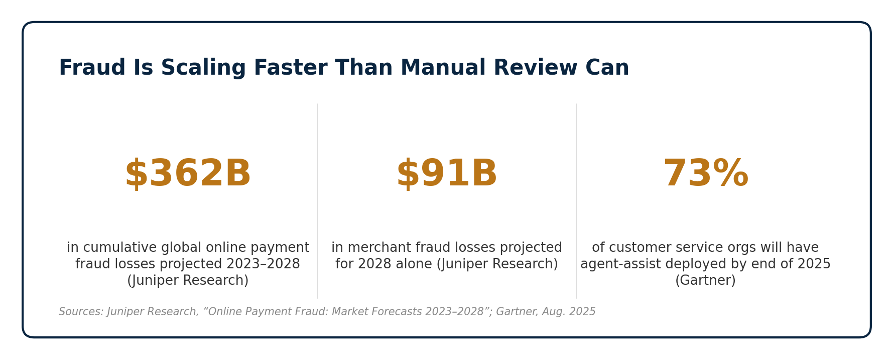
According to a Juniper Research, more than $362 billion is the projected cumulative global online payment fraud losses between 2023 and 2028, with 2028 incurring losses of $91 billion. Those numbers describe a trajectory, not a snapshot: fraud losses have grown in every Juniper forecast cycle for the past five years, driven by faster payment rails, more sophisticated social engineering, and increasingly, fraud tooling that itself uses AI to probe for weaknesses faster than manual review can catch them.
For high-volume banks, card issuers, and lenders, this creates a math problem that headcount alone can’t solve. Doubling the fraud team doesn’t double capacity to review flagged transactions if the flagging itself is noisy – and manual review processes, however well-staffed, top out at a throughput ceiling that transaction volume keeps climbing past. The institutions managing this well aren’t the ones adding the most reviewers. They’re the ones redesigning the workflow around where human judgment adds the most value.
That redesign generally follows three components. First, monitoring gets tuned to reduce false positives – flagging transactions that actually warrant review, rather than generating volume that trains investigators to rubber-stamp alerts. Second, first-pass triage gets automated: pattern-matching against known fraud signatures, account history, and velocity checks happens before a case ever reaches a human queue, so investigators start from a pre-sorted, risk-ranked list rather than a raw firehose. Third – and most often skipped – investigation support tooling surfaces the relevant account history, prior disputes, and policy guidance inline, so an investigator isn’t reconstructing context from five different systems before they can even start the actual review.
None of this removes the human decision. It changes what the human is doing at the point of decision – reviewing a pre-triaged, context-rich case instead of screening raw alerts for relevance. Gartner reported that 73% of customer service organizations will have implemented some form of agent-assist by the end of 2025, and the same logic applies directly to fraud and dispute operations: the goal isn’t fewer people in the loop, it’s less of their time spent on the parts of the process that don’t require judgment.
The institutions that get this balance wrong tend to fail in one of two predictable directions. Either they under-automate and watch resolution times stretch as volume outpaces capacity, or they over-automate and start clearing cases without the documentation trail that regulators and reputational risk both demand. The workable middle ground keeps every automated step auditable – what was flagged, why, what a human reviewed, and what they decided – so speed and governance improve together instead of trading off against each other.
Fraud at scale isn’t a problem that gets solved. It’s a capacity gap that has to be managed continuously, and the institutions managing it best have stopped trying to out-hire it.
Proof Over Promise
Inspiro’s clients have sustained partnerships averaging over two decades, driven by consistent, measurable results. That longevity isn’t coincidental. It’s built on Lean Six Sigma discipline, senior-level attention, and a delivery model designed to produce outcomes that show up in your KPIs, not just on a slide deck. Beyond contact center operations, Inspiro’s Business Process Services (BPS) extend that same operational rigor to back-office functions, streamlining workflows and reducing process complexity across your entire organization. BPS and CX are integrated by design, meaning back-office efficiency directly powers front-office performance. The result is a seamless, end-to-end delivery model that drives measurable value from topline customer experience to bottom line operational savings. If your company is facing rising costs, quality gaps, or scaling pressure, a conversation with an Inspiro expert is a practical next step.