



A follow-the-sun model hands support between regional teams – typically Americas, EMEA, and APAC – so a ticket never has to wait for a single timezone to wake up. Outsourced tech support companies use it because global SaaS customers expect continuous coverage, but the model only works if every handoff carries full context, not just an open ticket.
What is a follow-the-sun IT support model, and why do outsourced tech support companies use it?
SaaS companies scale their user base faster than they scale their support organization, and a single-time zone desk starts failing the moment users spread past two continents. The failure mode is familiar to any CIO who has fielded a 2 a.m. escalation call personally: an outage or access issue lands outside business hours, the on-call engineer is improvising without documentation, and the customer experiences the gap as “this company doesn’t have its act together” regardless of how good daytime support actually is.
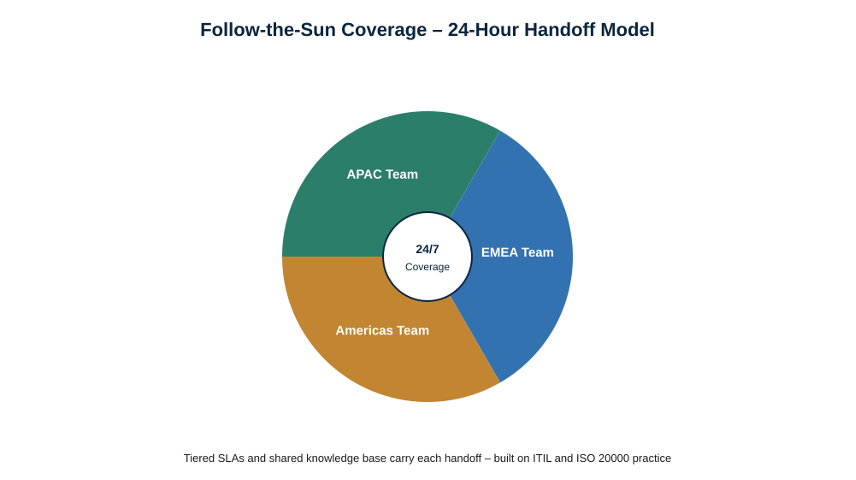
A follow-the-sun model solves the time zone problem, but the staffing map is the easy part. What actually determines whether a handoff works is whether the receiving team inherits full context – not just an open ticket, but the customer’s history, the troubleshooting steps already tried, and a shared understanding of what “resolved” means for that account. Built on ITIL and ISO 20000 practice, that means a common knowledge base across every region, tiered SLAs that define response and resolution targets consistently regardless of which team picks up the ticket, and native integration with the ITSM platform already in place – ServiceNow or Jira – so nothing gets re-keyed or lost at the handoff. That’s the detail that separates outsourced tech support companies offering genuine follow-the-sun coverage from ones simply staffing three shifts under one brand.
The staffing model itself typically runs three regional teams – Americas, EMEA, and APAC – each covering roughly an eight-hour local-daytime window, with a two-hour overlap on either side for live handoff calls rather than a cold ticket transfer. That overlap window is where follow-the-sun models succeed or fail in practice: teams that skip it save headcount and lose continuity; teams that keep it pay for a small overlap and gain a desk that genuinely never sleeps.
For technology and SaaS companies with 200–2,000 employees expanding into new geographies, follow-the-sun coverage is increasingly a baseline expectation rather than a differentiator – which makes the operational discipline behind it, not the marketing claim of “24/7 support,” the thing worth evaluating in a vendor review.
Proof Over Promise
Inspiro’s clients have sustained partnerships averaging over two decades, driven by consistent, measurable results. That longevity isn’t coincidental. It’s built on Lean Six Sigma discipline, senior-level attention, and a delivery model designed to produce outcomes that show up in your KPIs, not just on a slide deck. Beyond contact center operations, Inspiro’s Business Process Services (BPS) extend that same operational rigor to back-office functions, streamlining workflows and reducing process complexity across your entire organization. BPS and CX are integrated by design, meaning back-office efficiency directly powers front-office performance. The result is a seamless, end-to-end delivery model that drives measurable value from topline customer experience to bottom line operational savings. If your company is facing rising costs, quality gaps, or scaling pressure, a conversation with an Inspiro expert is a practical next step.

