



A chatbot answers a question inside a conversation; agentic AI reasons across a multi-step problem, decides what to do, and takes the action inside a connected system – resetting a password and updating the ticket record, not just explaining how. That distinction is what separates a genuine IT service company running agentic AI in production from a scripted bot relabeled as an “agent” for a sales deck.
What is agentic AI, and how is it different from a chatbot in IT support?
Most IT chatbots still hand off to a human the moment a request gets specific. Ask one to reset a password and it can often walk you through the self-service flow; ask it to reset a password, re-provision a license tied to a departmental transfer, and update the corresponding ServiceNow record, and it reaches its limit fast. Agentic AI is built to clear that limit – chaining reasoning, tool use, and system access to complete multi-step requests without a ticket ever reaching a human queue.
Gartner has put a number on where this is heading: by 2029, agentic AI is projected to autonomously resolve 80% of common customer service issues without human intervention, driving a 30% reduction in operational costs. Research by Gartner indicates that task-specific AI integration within corporate software is set to surge, expanding from less than 5% at the start of 2025 to 40% by the close of 2026.
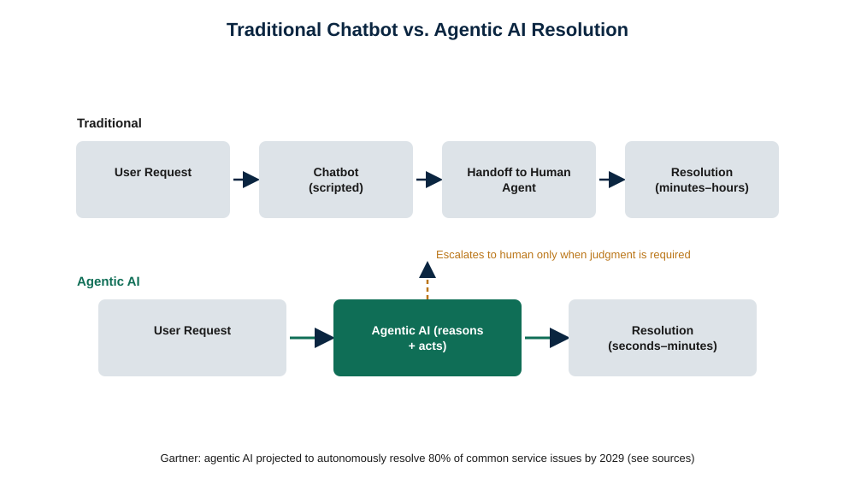
That trajectory doesn’t mean agentic AI is ready to run an IT service desk unsupervised today. Analysts tracking the space through 2026 note a split between genuine agentic capability – systems that reason across multi-step problems and take autonomous action inside enterprise systems – and “chatbots dressed up as agents,” where a relabeled scripted bot handles roughly 20–30% of interactions and stalls on anything more complex. The gap between the two is usually procurement discipline, not the underlying technology.
For IT service management specifically, the near-term use case is narrower and more defensible: password resets, standard access provisioning, license reassignment, and routine account lookups – categories where the action is well-defined, the system integrations already exist, and the risk of an incorrect autonomous action is low and easily reversible. More judgment-intensive categories – security exceptions, access to sensitive systems, anything touching a compliance boundary – stay routed to a human, with the agent handling triage and context assembly rather than the decision itself.
Inspiro’s Copilot-ready service desk uses agentic AI in exactly that scoped way: autonomous resolution for the categories where it’s proven, and a clean escalation path everywhere else, so the technology protects first-contact resolution instead of becoming a second layer of noise for users to work around. It’s the same distinction technology buyers should apply when evaluating any IT service company that claims agentic AI capability.
Proof Over Promise
Inspiro’s clients have sustained partnerships averaging over two decades, driven by consistent, measurable results. That longevity isn’t coincidental. It’s built on Lean Six Sigma discipline, senior-level attention, and a delivery model designed to produce outcomes that show up in your KPIs, not just on a slide deck. Beyond contact center operations, Inspiro’s Business Process Services (BPS) extend that same operational rigor to back-office functions, streamlining workflows and reducing process complexity across your entire organization. BPS and CX are integrated by design, meaning back-office efficiency directly powers front-office performance. The result is a seamless, end-to-end delivery model that drives measurable value from topline customer experience to bottom line operational savings. If your company is facing rising costs, quality gaps, or scaling pressure, a conversation with an Inspiro expert is a practical next step.


