
There’s no single number, but the framework is straightforward: multiply fully loaded cost per ticket by monthly ticket volume in the L1/L2 band, then weigh that against what it costs to outsource IT services for the same deflection. For most mid-market technology companies, the engineering hours locked up in ticket noise cost more than outsourcing them – which is why ticket deflection ROI, not headcount reduction, is the right frame for the build-vs-outsource decision.
How much does L1/L2 ticket noise cost, and is outsourcing IT support worth it?
Low-value, repetitive tickets rarely appear as a line item on an IT budget, which is exactly why they’re so easy to underfund and so expensive to ignore. They’re distributed across dozens of engineers’ partial attention in ten-minute interruptions, password resets between meetings, access requests answered from a phone in the elevator. None of that shows up as a single visible cost. All of it adds up.
Industry data on where that cost hides is consistent. A 2026 analysis of more than 50,000 service desk tickets across 30+ organizations found that automated workflows and virtual agents now deflect 20% to 40% of routine requests, cutting support backlogs by as much as 35% where they’re properly implemented. The gap between organizations at the low end of that range and the high end is rarely the technology – it’s whether ticket deflection was designed as a program or left to accumulate ad hoc.
The framework CIOs need starts with three numbers: cost per ticket (fully loaded engineer time, not just the interaction), tickets per month in the L1/L2 band, and current first-contact resolution rate. Cross-industry, FCR sits around 70% as a general benchmark, with research data showing world-class performance above 80% is achieved by only a small minority of support organizations. Every percentage point of FCR improvement compounds: fewer escalations to Tier 2, fewer repeat contacts, and a roughly proportional lift in satisfaction for each point gained.
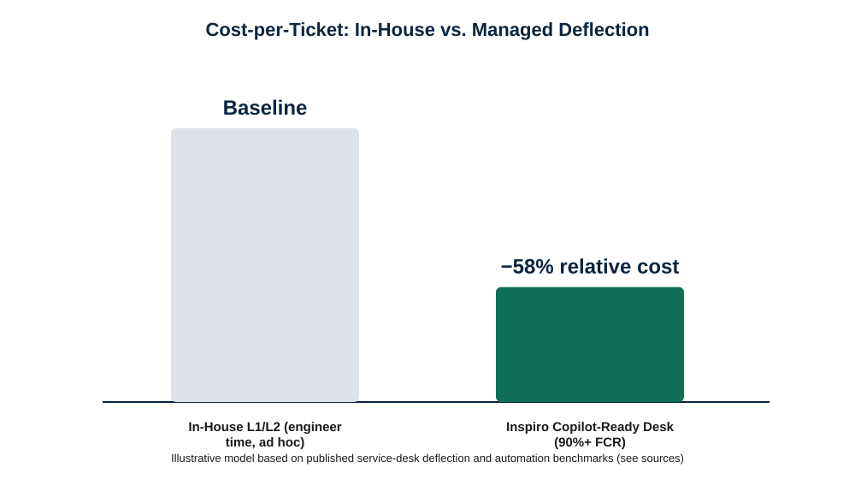
Run the math on a mid-market technology company with 1,000 employees and a typical 15–20% monthly IT contact rate, and the engineering hours locked up in L1/L2 noise usually land in the thousands per year – hours that could otherwise go to platform work, security hardening, or the Copilot and AI enablement projects competing for the same team’s attention.
That’s the case for treating ticket deflection as a designed program rather than an emergent side effect. Inspiro’s Copilot-ready, ITIL-aligned service desk model is built around the same first-contact-resolution discipline that drives the benchmarks above 90%, engineered specifically to take the deflectable volume off internal teams so their time goes toward work only they can do. It’s also why more CIOs are comparing that internal cost directly against what it would take to outsource IT services to a partner built around first-contact-resolution discipline.
Enterprise Rigor, Without the Overhead
Inspiro works with Fortune 1000 companies across the US, APAC, and ANZ to deliver contact center outcomes that show up in real numbers. Unlike mega-BPO providers, Inspiro’s right-sized model means senior practitioners stay close to your operation, making faster decisions and delivering custom-fit solutions without the bureaucratic drag. That same enterprise-grade discipline extends into Inspiro’s Business Process Services (BPS), where structured process improvement drives efficiency across back-office functions like finance, HR, and compliance. BPS and CX aren’t separate offerings. They’re built to work together, so improvements in back-office accuracy and throughput directly strengthen front-office performance. For organizations managing complex operations across multiple geographies, this integrated model delivers measurable value at every layer of the business. If your CX operation needs that level of rigor without the overhead, let’s talk specifics.