
There is a particular kind of failure that only happens on the days a retailer can least afford it. Wait times stretch. Chat queues back up. Order-status questions pile in faster than agents can clear them. Somewhere in the middle of it, a customer who was going to buy again decides not to.
Why Does Customer Experience in Retail Break Down During Peak Season?
This is the operational question behind every peak-season conversation about customer experience in retail: not whether volume will spike, but whether the workflows underneath retail CX were built to absorb it.
What makes this failure worth writing about is that it is entirely predictable. Nobody is surprised by Black Friday. Nobody is surprised that a product launch generates questions or that a delivery disruption generates complaints. And yet peak season continues to break retail operations year after year, which suggests the problem is not forecasting. It is that most retail CX operations are built for the average day and asked to perform on the exceptional one.
The gap is structural, not seasonal
Inspiro’s retail practice frames the issue directly: retail demand surges quickly and without warning, placing constant pressure on customer-facing and fulfillment operations. Promotions drive sudden volume. Product launches, peak seasons, and fulfillment disruptions expose operational gaps immediately. The word doing the work in that description is “expose.” The gaps were already there. Volume just made them visible.
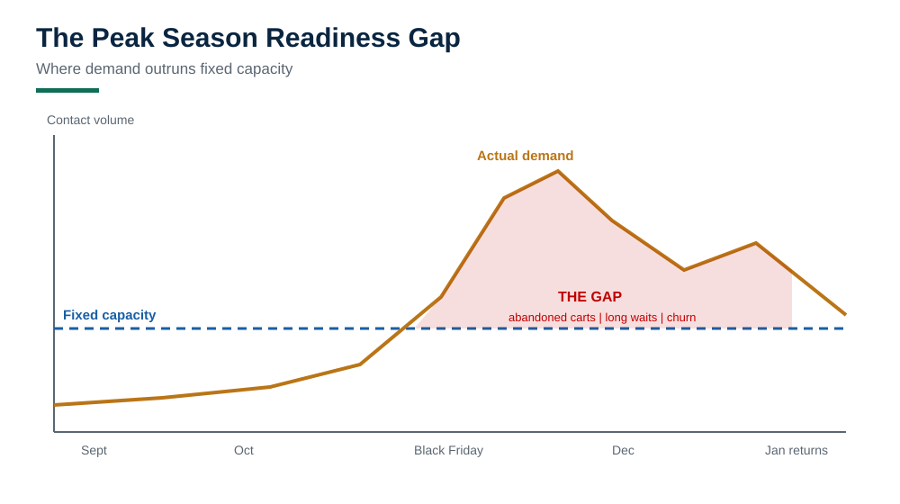
The scale of the swing is worth being precise about. Industry reporting places holiday-period customer service inquiry increases in the range of 60 to 80 percent for many organizations, with some contact centers seeing volumes triple overnight around Black Friday and Cyber Monday. Retail-sector analysis has tracked call volume rising roughly 41 percent year over year in the five days between Thanksgiving and Cyber Monday alone. For a team running at healthy utilization in October, that is not a stretch. That is a different operating model.
Where retail CX actually buckles
In practice, the failure points cluster in four places, and none of them are exotic:
- Contact volume during delivery disruptions. A single carrier delay generates a wave of “where is my order” contacts that has nothing to do with anything the CX team did wrong, and everything to do with whether they have capacity to answer.
- Channel inconsistency. A customer who starts in chat, escalates to email, and finishes on the phone should not have to re-explain the problem three times. Under load, that is exactly what happens.
- Post-purchase issues. Returns, refunds, and exceptions do not spike during peak week; they spike in the weeks after, when the team is already exhausted and the seasonal staff have been released.
- Speed expectations that do not flex. Customers do not lower their standards because a retailer is busy. Research consistently finds speed and convenience at the top of what defines a good experience, and PwC’s widely cited consumer research found that roughly a third of customers would walk away from a brand they love after a single bad experience.
When teams cannot flex fast enough, revenue is lost before issues ever reach a dashboard — through abandoned carts, negative reviews, and customers who do not return.
What “peak-ready” actually means
Peak readiness is often discussed as a staffing question, which is why it usually fails. Hiring seasonal agents in October solves a headcount gap while leaving the process gap untouched — and a poorly defined returns workflow staffed by twice as many people is still a poorly defined returns workflow. It just costs more.
A more useful definition has three parts. First, elasticity: the ability to add and release capacity without a six-week ramp, which generally means a delivery partner with a bench rather than a fixed in-house team. Second, process stability: workflows mapped and controlled well enough that a new agent can execute them correctly in week one. Third, intelligent enablement: automation and knowledge-surfacing that absorb the routine so human attention goes to the interactions that actually need judgment.
That third element is where a lot of retailers over-invest in the wrong direction. Inspiro’s retail model is explicit that during peak demand, speed and consistency matter more than sophistication — intelligence in retail operations must help teams respond immediately without slowing the customer down. A sophisticated AI deployment that adds a step to the agent’s workflow is a net negative during peak. Workflow automation, faster knowledge retrieval, and automatic interaction summaries are net positives, because they give time back.
The operational test
- If contact volume doubled next Tuesday, how long until we have qualified capacity on the floor?
- Can a new agent complete a returns exception correctly without escalating, in their first week?
- Do our channels share context, or does each one start from zero?
- Who owns the post-purchase backlog in January, when the seasonal team is gone?
A retailer can pressure-test its own readiness with four questions, and the answers tend to be revealing:
Most retail organizations can answer one or two of these confidently. The ones that can answer all four tend to be the ones that treated peak readiness as a year-round operating discipline rather than a Q4 project — and they tend to be the ones whose peak season looks, from the customer’s side, unremarkable.
That is the actual goal. Not a heroic Q4. An uneventful one.
Results You Can Measure
Lean Six Sigma-led process discipline has helped Inspiro clients reduce average handling times, improve first-contact resolution rates, and lower cost per interaction. These aren’t projections. They’re documented outcomes built on repeatable methodology and more than two decades of operational experience across industries. Inspiro’s Business Process Services (BPS) extend that same discipline beyond the contact center, applying structured process improvement to back-office functions like finance, HR, and compliance. BPS isn’t a bolt-on. It’s an integrated capability designed to drive efficiency gains across the full business lifecycle, reducing complexity while improving accuracy and throughput. Whether you’re managing high inbound volume or trying to close the gap between your current CSAT scores and where they need to be, Inspiro can show you what that discipline looks like applied to your specific operation.