


By: Maria Rita de Leon, Associate Vice President, Sales and Business Development
When travel breaks, you have minutes — not hours — to keep a customer. Win them, and a cancelled flight becomes a loyalty moment. Lose them, and no program wins the guest back.
How can travel brands recover customer loyalty after a flight disruption?
Travel brands recover loyalty after a disruption by resolving the guest’s issue in a single contact, communicating proactively, and treating customer experience in travel and back-office processing as one workflow. Fast, first-contact resolution — not compensation — is what turns hospitality customer experience from a liability into a loyalty signal.
Travel runs on moments that go wrong. Weather grounds aircraft, systems fail, and a single cancellation can cascade into thousands of stranded guests needing help at once. The brands travelers forgive are not the ones that avoid disruption — that is impossible — but the ones that respond well in the minutes immediately after.
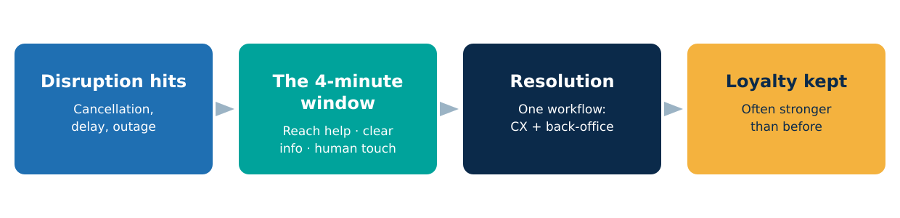
Those minutes matter more than most operators realize. A traveler who has just learned their flight is cancelled forms an impression of your brand almost instantly, based on three things: how fast they can reach help, how clearly they are told what happens next, and whether the resolution feels personal rather than processed. Get those right and you keep the guest. Get them wrong and no loyalty program will save the relationship.
Why effort beats delight in a disruption
Decades of customer research point in the same direction: in service interactions, reducing customer effort predicts loyalty far better than trying to delight. The single biggest driver of effort is having to make contact again because the issue was not resolved the first time. In a disruption, that means the goal is not a grand gesture — it is a fast, complete, first-contact resolution.
This is harder than it sounds because demand spikes exactly when capacity is thinnest. Contact volumes surge, agents are stretched, and the temptation is to push everyone to self-service. That works for the routine — status updates, standard rebooking options — but it fails the stranded family who need judgment and reassurance.
Resolve it as one workflow
The deepest cause of slow recovery is structural: a rebooking the contact center promises but the back office has not processed, a refund approved but never cleared. From the guest’s perspective, the problem is not solved until the new itinerary is confirmed and the money or credit has actually moved. Brands that treat customer experience and back-office processing as a single workflow compress resolution time and remove the contradictions that turn one bad moment into a lost customer.
Handled this way, disruption becomes one of the strongest loyalty signals you can send. Guests don’t expect perfection — they know things break. What they remember is whether you showed up: fast, clear, and as one team. That’s how a bad moment turns into impact.
Enterprise Rigor, Without the Overhead
Inspiro works with Fortune 1000 companies across the US, APAC, and ANZ to deliver contact center outcomes that show up in real numbers. Unlike mega-BPO providers, Inspiro’s right-sized model means senior practitioners stay close to your operation, making faster decisions and delivering custom-fit solutions without the bureaucratic drag. That same enterprise-grade discipline extends into Inspiro’s Business Process Services (BPS), where structured process improvement drives efficiency across back-office functions like finance, HR, and compliance. BPS and CX aren’t separate offerings. They’re built to work together, so improvements in back-office accuracy and throughput directly strengthen front-office performance. For organizations managing complex operations across multiple geographies, this integrated model delivers measurable value at every layer of the business. If your CX operation needs that level of rigor without the overhead, let’s talk specifics.
