
By: Chris Fajardo
Peak season shouldn’t mean longer queues and rising costs. Build operations that flex with demand and you achieve more with less — holding quality through the surge while cost-to-serve follows the curve back down.
How do travel and hospitality brands scale customer service during peak season?
Leading travel brands scale customer service in the hospitality industry by cross-training teams, accelerating agent readiness before demand peaks, and pairing an elastic back-office with disciplined customer experience management in hospitality — so quality holds through the surge instead of dipping when it matters most.
Every travel brand knows the rhythm: demand swings by season, by event, and sometimes by the hour. The problem is that most operations are sized for the average and then scramble when reality departs from it. Peak arrives, volume multiplies, queues lengthen, and quality slips — precisely when the most guests are watching. Contact-center leaders feel this acutely. Rising volumes and persistent agent attrition make it hard to staff up fast enough, and reactive hiring guarantees a training lag that shows up as inconsistent service.
Flex is a design choice, not a staffing emergency
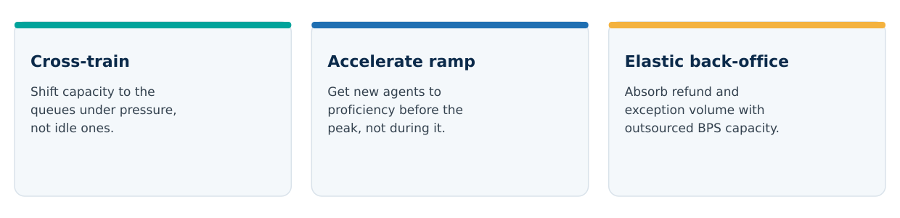
Operations that hold quality through peaks share a common trait: they treat flexibility as something engineered in advance, not improvised under pressure. Three levers do most of the work — cross-training so capacity can move to whichever queue is surging, accelerated training so new agents reach proficiency before the peak rather than during it, and an elastic back-office that can absorb the refund and exception volume a surge generates.
The training lever is the one most often underestimated. When ramp time is long, every seasonal hire is a liability until they are proficient. Cutting that ramp dramatically changes the math — Inspiro’s own use of Simulate cut mock-simulation time by 57%, turning a perennial weakness into a repeatable, fast ramp.
Outsourced capacity that scales with the curve
The back-office lever is where outsourced business process services earn their place. A specialist BPS partner provides capacity that expands and contracts with demand instead of being capped by in-house headcount — which is exactly why leaders increasingly treat shared and outsourced services as scalable, end-to-end ownership rather than fixed overhead.
Built this way, the scramble becomes a controlled ramp. Quality holds whether volume doubles for a holiday peak or eases in the shoulder season — and cost-to-serve follows demand instead of sitting stranded at peak all year. That’s achieving more with less, season after season.
Enterprise Rigor, Without the Overhead
Inspiro works with Fortune 1000 companies across the US, APAC, and ANZ to deliver contact center outcomes that show up in real numbers. Unlike mega-BPO providers, Inspiro’s right-sized model means senior practitioners stay close to your operation, making faster decisions and delivering custom-fit solutions without the bureaucratic drag. That same enterprise-grade discipline extends into Inspiro’s Business Process Services (BPS), where structured process improvement drives efficiency across back-office functions like finance, HR, and compliance. BPS and CX aren’t separate offerings. They’re built to work together, so improvements in back-office accuracy and throughput directly strengthen front-office performance. For organizations managing complex operations across multiple geographies, this integrated model delivers measurable value at every layer of the business. If your CX operation needs that level of rigor without the overhead, let’s talk specifics.