



Retail CX leaders are under real pressure to deploy AI, and much of that pressure is not coming from customers. Gartner has reported that the overwhelming majority of customer service leaders are under executive pressure to implement AI — a mandate arriving with a deadline attached and, frequently, without a defined problem to solve.
Where Should Retailers Use AI in Customer Experience?
The honest answer to where AI belongs in CX for ecommerce is narrower than most vendors selling AI-powered digital transformation solutions want to admit — which is precisely the argument this piece makes.
The industry’s own experience over the past two years suggests caution is not the same as timidity. Gartner’s widely quoted projection that agentic AI will autonomously resolve 80 percent of common customer service issues by 2029 has been accompanied by a set of far less quoted corrections: that by 2027, half of the companies attributing headcount reductions to AI will rehire for similar functions under different titles, and that by 2030 the cost per resolution for generative AI in customer service will exceed three dollars — higher than many offshore human agents.
Full automation will be prohibitively expensive for most organizations. The leaders will use AI to drive customer engagement rather than to cut costs. — Gartner, on 2026 customer service AI economics
For retail specifically, that reframing matters, because retail CX has an unusually clear split between interactions that are genuinely routine and interactions where getting it wrong is expensive.
A sorting framework
The useful question is not “should we use AI?” but “which interactions, and in what role?” Sorting retail contacts along two axes — volume and judgment required — produces four quadrants with very different answers.
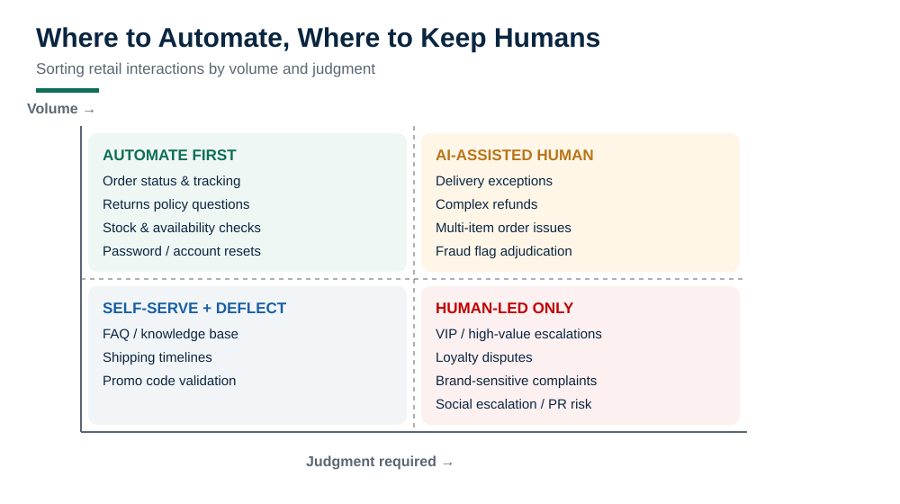
High-volume, low-judgment contacts are the automation case, and in retail they are a large share of the total: order status and tracking, returns policy questions, stock and availability checks, account resets. These are questions with deterministic answers. Automating them is not a risk to brand experience; leaving them to queue behind complex cases is.
The opposite quadrant is where automation goes wrong. VIP and high-value escalations, loyalty disputes, brand-sensitive complaints, and anything with social or PR exposure are low-volume and high-judgment. The cost of a wrong answer here is not a rehandled ticket — it is a public one. These stay human-led, and the AI investment that pays off is the one making the human faster and better informed, not the one replacing them.
Quiet technology
Inspiro’s framing for its retail enablement approach is worth borrowing because it inverts the usual emphasis: during peak demand, speed and consistency matter more than sophistication, and intelligence in retail operations must help teams respond immediately without slowing the customer down. Technology works quietly in the background, helping teams move faster while keeping customer interactions personal and effective.
In practice that means the Inspiro iX enablement layer concentrates on three things that give agents time back rather than adding steps: workflow automation, knowledge surfacing for faster resolution, and interaction summaries and quality insights. None of those are customer-facing. All of them shorten handle time and reduce the cognitive load on an agent working a queue during peak.
This is also the shape of the credibility argument. Altius Inspiro’s Inspiro iX suite was recognized with an International Innovation Award in the Service and Solution category for its integration of human expertise, operational excellence anchored on Lean Six Sigma, and artificial intelligence — which is a description of AI positioned as a layer over disciplined process, not a substitute for it.
The brand voice problem
There is a specific objection that comes up in every retail AI conversation and deserves a direct answer: automation flattens brand voice. This is often true, and it is a legitimate reason for restraint at the top of the judgment axis.
But it argues for a particular deployment pattern rather than against AI altogether. Automate the interactions where brand voice is largely irrelevant — nobody has ever formed a brand impression from a tracking-number lookup. Preserve human handling where voice is the value. And use AI in the middle band to give agents the context they need to sound informed rather than scripted, which is usually what customers actually mean when they say an interaction felt impersonal.
Where to start
A pragmatic sequence for retail teams looks like this. Start by measuring contact mix against the two axes above; most teams are surprised by how concentrated their volume is in a handful of deterministic intents. Automate the top of that list and measure deflection quality, not just deflection rate — a deflected contact that returns tomorrow was not deflected. Then deploy agent-assist into the middle band and measure handle time and first-contact resolution. Leave the top-right quadrant alone until the first three steps are stable.
The retailers getting the most out of AI in CX are not the ones who automated the most. They are the ones who were precise about where automation helps and disciplined about where it doesn’t — which, given where the cost curves are heading, is also turning out to be the cheaper path.
Enterprise Rigor, Without the Overhead
Inspiro works with Fortune 1000 companies across the US, APAC, and ANZ to deliver contact center outcomes that show up in real numbers. Unlike mega-BPO providers, Inspiro’s right-sized model means senior practitioners stay close to your operation, making faster decisions and delivering custom-fit solutions without the bureaucratic drag. That same enterprise-grade discipline extends into Inspiro’s Business Process Services (BPS), where structured process improvement drives efficiency across back-office functions like finance, HR, and compliance. BPS and CX aren’t separate offerings. They’re built to work together, so improvements in back-office accuracy and throughput directly strengthen front-office performance. For organizations managing complex operations across multiple geographies, this integrated model delivers measurable value at every layer of the business. If your CX operation needs that level of rigor without the overhead, let’s talk specifics.
