
In the strongest telecom back offices, BPS and AI don’t have a hard boundary – Lean Six Sigma owns root-cause discipline and standardization, while AI owns the speed of detecting the next instance of a problem before it becomes a pattern. By pairing human-led process optimization with automated anomaly detection, organizations eliminate operational silos that traditionally slow down remediation efforts. This integrated framework allows back-office teams to continuously refine performance metrics while mitigating risks before they impact service delivery.
Where Does BPS End and AI Begin in the Telecom Back Office?
For most of the outsourcing industry’s history, BPS and AI were discussed as though they were sequential – first you fix the process, later you automate it. That framing is out of date. In telecom back-office operations today, the strongest programs run Lean Six Sigma process discipline and AI detection as a single continuous system, not two phases.
The direction is clear at the industry level. Deloitte’s 2025 Global Business Services Survey found that approximately 58% of global business services organizations have already begun, or are actively planning, their GenAI journey – with finance and IT functions, the same domains that own telecom provisioning and billing operations, leading adoption of tools like automated invoice management and analytics dashboards. Separately, industry data suggests up to 60% of BPO providers have deployed some form of robotic process automation, and 45–55% of new BPO contracts now include AI or machine-learning components for customer service and analytics functions.
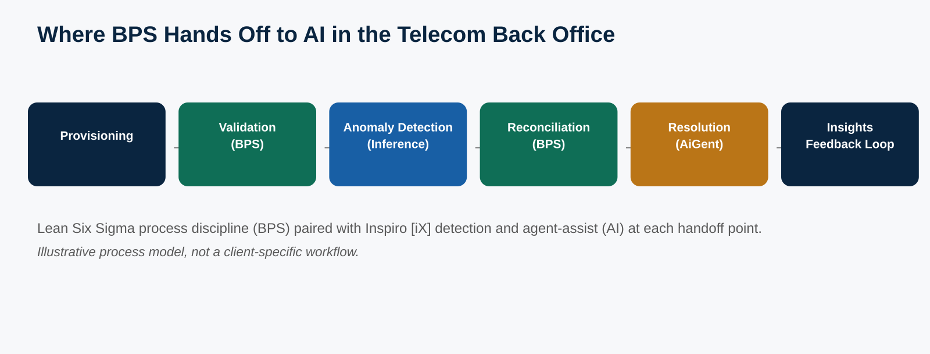
What this looks like in a telecom back office is a handoff chain, not a single tool: provisioning data is validated against the order (BPS), interaction and billing signals are continuously scanned for anomalies (Inspiro Inference), reconciliation closes the loop on usage and billing discrepancies (BPS), agents or automated workflows resolve flagged cases with full context (Inspiro AiGent), and the resolution data feeds back into process improvement (Inspiro Insights). Lean Six Sigma still owns the discipline of finding root causes and standardizing the fix. AI owns the speed of detecting the next instance before it becomes a pattern.
The mistake to avoid is treating this as an AI replacing BPS story. The Deloitte GBS data shows organizations pursuing GenAI specifically to achieve process standardization, cost reduction, and better end-to-end ownership – process objectives, delivered faster. In telecoms specifically, where provisioning and billing complexity scales directly with subscriber growth, that combination is what makes the “without adding headcount” promise credible rather than aspirational.
The operators asking “should we invest in BPS or AI” are asking the wrong question. The ones already ahead are asking where in the process the handoff between the two should happen.
Proof Over Promise
Inspiro’s clients have sustained partnerships averaging over two decades, driven by consistent, measurable results. That longevity isn’t coincidental. It’s built on Lean Six Sigma discipline, senior-level attention, and a delivery model designed to produce outcomes that show up in your KPIs, not just on a slide deck. Beyond contact center operations, Inspiro’s Business Process Services (BPS) extend that same operational rigor to back-office functions, streamlining workflows and reducing process complexity across your entire organization. BPS and CX are integrated by design, meaning back-office efficiency directly powers front-office performance. The result is a seamless, end-to-end delivery model that drives measurable value from topline customer experience to bottom line operational savings. If your company is facing rising costs, quality gaps, or scaling pressure, a conversation with an Inspiro expert is a practical next step.